
Case study · Editorial archive
The Lost Blues Archive
An archive for the artists, shellac records and royalty disputes the record industry left behind — built to read like a reference work, not a feed.
The brief
Material that deserved an archive, not a blog.
The Lost Blues Archive collects what is normally scattered across collector forums, out-of-print discographies and court filings: artists the histories skipped, records that survive in single digits, and the publishing money that never reached the people who made the recordings.
The site states its purpose plainly — preserving the legends, rediscovering the forgotten, keeping the blues alive. That promise sets the design problem: an archive has to look like it will still be readable in ten years, and every entry has to be findable without a search box doing the thinking.
The design
A quiet frame around loud material.
The visual direction stays archival: warm paper tones, a serif voice for the editorial text, and accents used only where they help you move between entries. Nothing competes with the subject matter, which is already dramatic enough.
The layout leads with reading. Headings carry the argument, the supporting text is set at a comfortable measure, and the archive's own categories — artists, records, regions, timeline — sit in a navigation model that repeats consistently across the site.
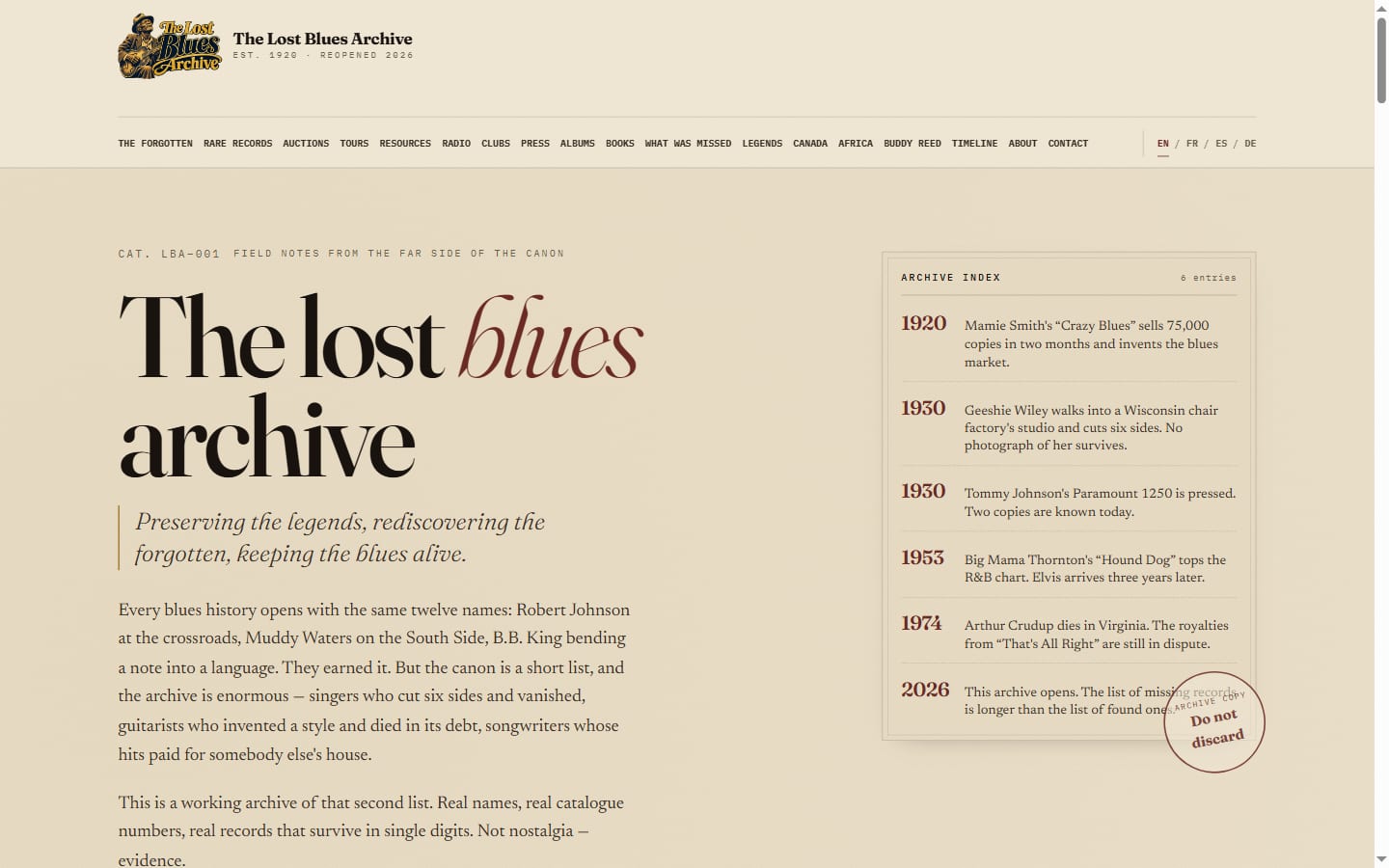
Screenshot of the live site, captured from the public homepage at browser width.
What the archive holds
Six threads that hold the site together.
Each section is built to be read on its own and to lead into the others, so a visitor can arrive from a search result and still find their way around.
The forgotten
Artist profiles for musicians the standard histories skipped — Buddy Reed, Geeshie Wiley, Tommy Johnson, Big Mama Thornton, Jessie Mae Hemphill, Jimmy Dawkins and Ted Hawkins among them.
Rare records
Shellac rather than vinyl, pressing runs measured in single digits, and the difference between a record that is rare and one that is simply old.
Publishing, not royalties
The money trail: who was credited, who was paid, and why publishing rights rather than performance royalties decided which careers survived.
What was missed
The Depression and the scrapped masters, plus the careers that disappeared when the catalogue did — context that makes a single artist entry mean more.
Beyond the Delta
Regional threads that widen the frame, including Canadian and African material alongside the American south.
Timeline and resources
A chronological spine plus auctions, tours, radio, clubs, press, albums and books gathered in one index instead of scattered across pages.
How it was built
Structure first, surface second.
The archive was organised before it was styled. Entries share one shape, categories are finite and named, and the navigation reflects how the material is actually researched rather than how a template happens to divide a page.
The build is deliberately light: fast static pages, typography that carries long-form reading, and a layout that holds together from a phone in a record shop to a desktop used for writing.
- One entry structure reused across artists, records and regional threads
- Reading-first typography with generous measure and clear hierarchy
- Navigation that repeats the archive's own categories
- Responsive layout tested down to small phone widths
Project facts
- Status: live
- Year: 2026
- Type: editorial archive
- Scope: design, structure and front-end build
- Live at lostbluesarchive.online
Archival research, cataloguing and editorial decisions remain with the site's owner.
What this case study does not claim
- No traffic, sales, ranking or engagement results are claimed for this site.
- The archive's research, sourcing and editorial judgement are the owner's work, not the studio's.
- No awards, press coverage or client endorsements are implied.
- The preview above is a screenshot of the live public homepage on the date it was captured.
Next step
Building an archive, catalogue or reference site?
If you have material that needs structure before it needs styling — a catalogue, a research collection, a body of knowledge customers keep asking about — a short conversation will clarify what is realistic.